Honey Easter Handwritten Font for Crafters & Sellers
As someone who designs printable wedding invites, hand-paints boutique tags, cuts vinyl stickers for small-batch candles, and creates seasonal SVG bundles for Etsy—finding a script font that’s both charming and commercially reliable is rare. That’s why Honey Easter stands out in my font library: it’s not just another decorative handwritten typeface. It’s fresh, friendly, and thoughtfully built for real craft workflows—not just mockups.
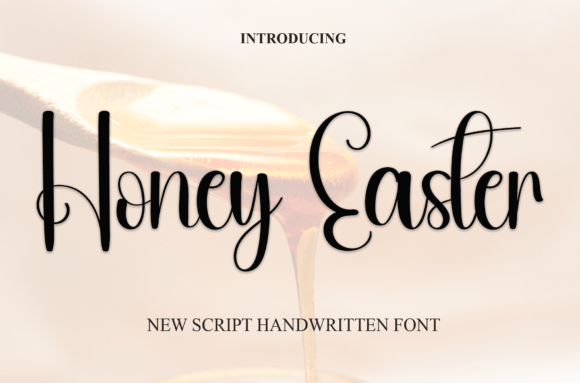
Honey Easter lives in the Script Amp category, which means it balances expressive energy with clean readability. Its lines are smooth but never overly flourished—no dramatic swoops that vanish when cut at 3/8” on a Cricut or blur on a matte sticker label. The letterforms feel intentionally rounded and open, giving names, phrases, and titles breathing room even at small sizes. It’s the kind of font you’d choose for a “Welcome to Our Farmhouse” chalkboard sign—and still trust to hold up on a 1” product tag stitched onto handmade lavender sachets.
I’ve used Honey Easter across dozens of physical and digital products: wedding welcome boards printed on kraft cardstock, birthday party printables with coordinating cupcake toppers, candle labels laser-printed on waterproof vinyl, and even embroidered tote bag designs where the font was traced as a stitch guide. What makes it work so consistently is its clarity. Unlike some ornate scripts that collapse into mush below 24pt, Honey Easter stays legible down to 14pt in print—and cleanly cuts at 10pt on Silhouette Studio with minimal node cleanup.
For greeting cards and invitations, Honey Easter shines in short, meaningful phrases: “Mr. & Mrs.,” “Join Us,” “Sweetest Day Ever,” or a single name centered on a foil-stamped save-the-date. It’s not designed for full paragraphs—but that’s intentional. As a display font, it excels where emotional tone matters most: conveying warmth, sincerity, and approachability without looking cutesy or dated. Customers notice that difference. A wedding invite set using Honey Easter feels personal, not generic—and that perception lifts perceived value, especially in premium stationery niches.
When designing product packaging—like apothecary-style soap labels or mini jam jar tags—I pair Honey Easter with a crisp sans serif (think Montserrat Light or Inter Regular). The contrast gives structure: Honey Easter carries the brand voice (“Wildflower Honey”), while the sans handles ingredients, weight, and batch numbers cleanly. For wall art or planner inserts, I’ll sometimes layer it over a subtle serif like Lora or Playfair Display—adding quiet elegance without competing for attention.
One thing I always check before committing to a font for commercial use is file support—and Honey Easter delivers. It includes OTF and TTF formats, basic OpenType features like standard ligatures and stylistic alternates (handy for swapping “&” or “ff” pairs), and consistent spacing across uppercase, lowercase, and numerals. No missing glyphs for common accents—so if you’re designing bilingual baby shower invites or French-inspired bakery packaging, you won’t hit a wall mid-project. It’s not a multilingual powerhouse, but it covers English, Spanish, French, German, and Portuguese essentials without glitching in Canva, Illustrator, or Affinity Designer.
Readability also matters for mockup previews. When uploading digital downloads to Etsy or Creative Market, I use Honey Easter in lifestyle mockups—on mugs, tea towels, and framed prints—because it renders cleanly at screen resolution. No fuzzy edges. No inconsistent kerning that throws off alignment in layered PSD files. That consistency saves time when updating templates or building bundle kits with coordinated fonts and graphics.
Practical tip: For small stickers (under 1.5”) or iron-on transfers, avoid using Honey Easter for full sentences. Stick to one- or two-word highlights—“Yes!”, “Hello Love”, “Made With Joy”—and always test-cut at your final size first. I keep a quick reference sheet: Honey Easter works best at 16–48pt for printed cards, 20–60pt for signs and wall art, and 12–24pt for labels and tags depending on material finish. Matte surfaces forgive minor tracking issues better than glossy vinyl—so adjust spacing slightly tighter for shiny substrates.
Commercial licensing is non-negotiable for sellers—and Honey Easter comes with a clear, straightforward commercial license. That means you can use it in physical products you sell (invitations, mugs, shirts), digital downloads (planner pages, Canva templates, SVG cut files), client work (logo lockups, shop signage), and even merchandise (tote bags, enamel pins, greeting card sets). No hidden restrictions. No per-unit fees. Just one license that scales with your shop—whether you’re shipping 10 orders a month or 1000.
What really seals the deal for me is how Honey Easter supports brand consistency across touchpoints. Imagine launching a spring-themed candle line: Honey Easter on the front label (“Lemon Blossom”), the same font on the matching thank-you card tucked inside the box, and reused in your Instagram story highlight icons. That repetition builds recognition—not just visually, but emotionally. Customers begin to associate that gentle, sunlit handwriting with your shop’s care and authenticity.
It’s also versatile enough for seasonal shifts without feeling forced. Swap out florals for Easter eggs, swap out pastels for harvest tones—and Honey Easter still fits. I’ve used it for Easter egg hunt maps, Mother’s Day tea towel prints, summer picnic menus, and even fall farmers’ market banners. Its “fresh and neat” personality holds up year-round because it avoids trend-heavy quirks—no exaggerated bounce, no forced irregularity. Just honest, joyful handwriting that serves the product first.
If you're curating a working font kit for your creative business—one that balances beauty, function, and license clarity—Honey Easter earns its place alongside your go-to sans serifs and reliable serifs. It’s not flashy. It doesn’t try to be everything. But for crafters who need a handwritten font that performs, prints well, cuts cleanly, and connects with customers? Honey Easter is quietly essential.